Field Test: Can a Visiting Angler Go Portugal Fishing Legally in One Day?
I have a habit of turning holidays into informal experiments. Not the kind with beakers and clipboards, but the kind where I write down a hypothesis before I go and then see whether reality cooperates. So when a cheap flight to Lisbon landed in my lap, I set myself a single question: can a visiting angler be fully legal and actually fishing within one day of stepping off the plane? This is the field report from that test, covering portugal fishing, the paperwork nobody warns you about, and what the coastline actually demands from your tackle.
Hypothesis and Method
My working hypothesis was simple: the bureaucratic side of fishing in portugal would be the bottleneck, not the fishing itself. I predicted that a recreational sea angler on the mainland needs a licence, that the application would be slow or confusing, and that I would lose at least a full day to it. My method was deliberately stripped back. I packed one travel rod, a small box of lures and rigs, a handful of weights, and no fixed itinerary beyond the coast. I gave myself twenty-four hours from landing to be standing on rocks with a line in the water, and I logged every step that got in the way.
The control variables were the things I could not change: the weather, the tide tables, and the fact that I do not speak fluent Portuguese. The variable I could control was preparation. Before leaving, I read that recreational sea fishing on mainland Portugal is administered through DGRM, the government body responsible for maritime and fishing matters. What I did not know was how quickly that could be handled from a phone.
Observations from the Coast
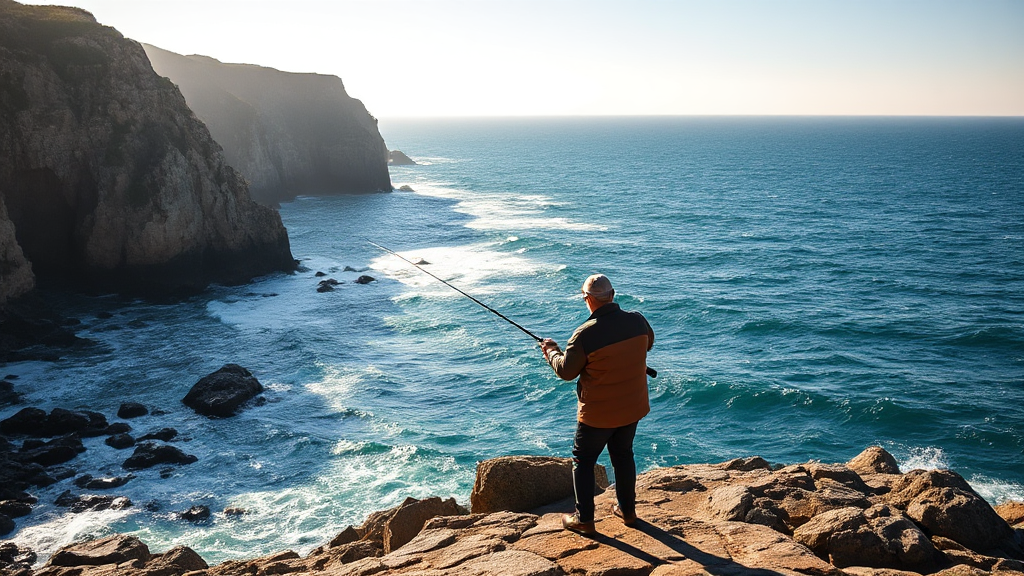
The first observation was that Portugal’s coastline is not one environment but several. Around the Algarve, the cliffs are tall, the water is deep close in, and access often means scrambling down a path rather than strolling onto sand. Further north, around the Lisbon area and the Atlantic-facing stretches, the sea is colder, rougher, and far less forgiving. The wind is the real variable here. I had assumed tide would matter most, but on the days I fished, the onshore breeze dictated where a lure could actually be cast and retrieved without tangling.
The second observation was about gear. My travel rod was fine for light spinning from rocks, but it was underpowered for the swell I met on the open Atlantic side. Anglers I spoke to were using longer rods, heavier braid, and lures in the forty-to-sixty-gram range to punch through the wind. If your experiment involves the west coast rather than the sheltered south, budget for more rod than you think you need. A landing net and a pair of grip pliers are not luxuries either, because the fish here have teeth and spines.
The third observation was the one that surprised me. The legal step, which I had assumed would be the slow part, was the fastest. I had expected a queue at an office, a form in a language I could not read, and a request for a tax number I do not have. Instead, the application was a short online process that took roughly three minutes on my phone, paid by card, and required no government portal login and no NIF. That single finding reshaped the whole experiment.
Results and What the Data Showed
By the numbers, the hypothesis was half right and half wrong. The licensing step did not cost me a day; it cost me a few minutes. What cost me time was everything else: finding access points, reading the sea, and learning that a spot which looks perfect at low tide can be dangerous two hours later. The practical result is that a visiting angler can indeed be legal and fishing within a day of landing, provided the licence is sorted early rather than left until the morning of the trip.
On the fishing itself, the results were modest but encouraging. I caught small bream and a couple of mackerel from rocks, and I lost several lures to snags that I never saw coming. Nothing trophy-sized, but the point of the experiment was not the catch. It was to test whether the system allows a casual visitor to participate honestly. It does, and the fishing license step is the least of your problems if you handle it before you travel.
One caution worth recording: rules differ between mainland Portugal and the islands, and they can change. Freshwater fishing is a separate matter entirely, with different permits and often different seasons. My test covered only recreational sea fishing on the mainland, so do not extrapolate it to a river in the interior or to the Azores without checking current requirements. The value of the experiment is the method, not a universal answer.
Conclusion and Repeatability
If I ran this experiment again, I would change three things. I would apply for the licence the week before flying, not the day after landing. I would bring a heavier rod and a wider range of lure weights. And I would build in a rest day, because scrambling over wet rocks in the Atlantic wind is more physical than it looks from a photograph.
The broader conclusion is that Portugal rewards the angler who treats preparation as part of the sport. The coastline is generous, the access is mostly free, and the legal framework is lighter than most visitors expect. What it punishes is improvisation at the last minute, whether that means guessing at tackle or guessing at rules. Run the test yourself, but run it in the right order: paperwork first, then tide tables, then the long walk down to the water.